GTA 6: how the wanted system redefines police chases and tension

What the trailers already reveal
GTA 6’s second trailer, released on May 6, 2025, runs just over two minutes. That’s a short window, but the community has pulled dozens of behavioral details from it: NPC reactions, traffic patterns, and law enforcement responses. Several analyses picked up by ScreenRant point to a structural shift in the wanted mechanic: police officers appear to track the player’s position more precisely, coordinate their movements differently, and respond to environmental context rather than simply spawning as scripted reinforcements.
In GTA 5, the wanted system operated on a relatively transparent zone-and-counter logic: crossing a threshold triggered a star level, and leaving a circular search radius after a fixed timer was enough to escape. It worked, but it was predictable. Experienced players could optimize their escape almost mechanically.
AI traffic that changes the nature of pursuit
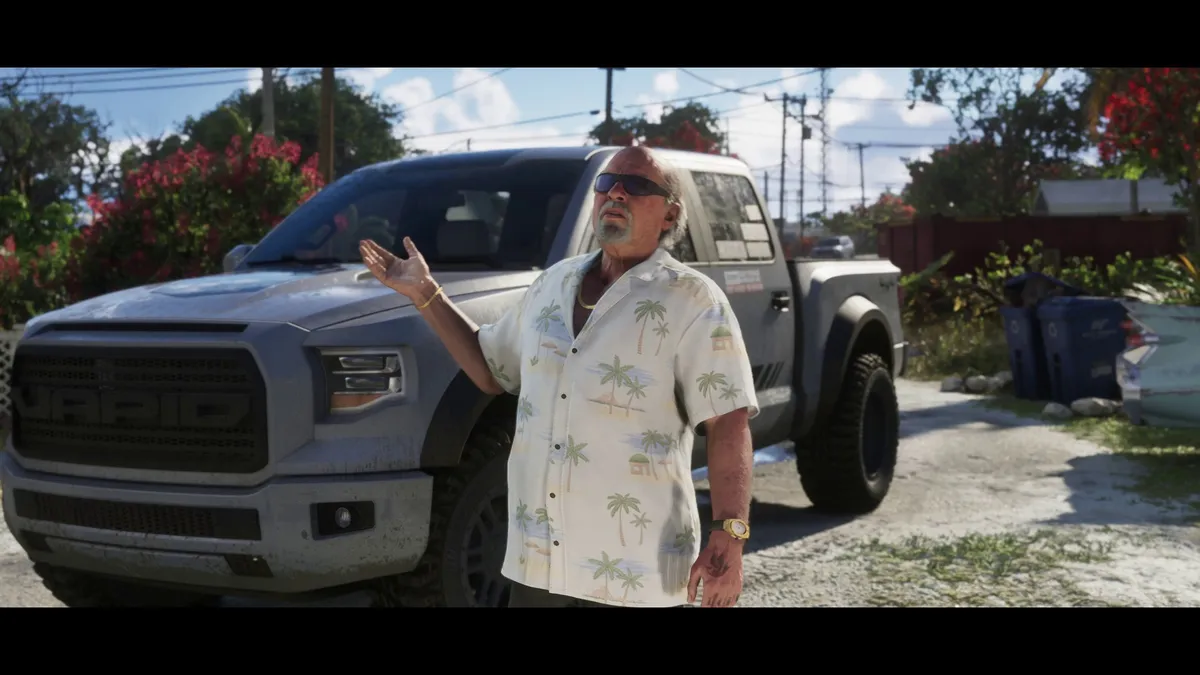
What distinguishes the chase sequences visible in trailer 2, according to fans who have analyzed it frame by frame, is civilian traffic behavior. Vehicles don’t simply stop or swerve: some drivers appear to react individually to danger, with certain NPCs exiting their cars while others attempt varied evasive maneuvers. Reports relayed by Jang and The News International also mention NPCs capable of making phone calls, raising the possibility of an active reporting mechanic.
If that reading is accurate, it fundamentally alters the geography of a chase. In GTA 5, traffic was a passive obstacle. In GTA 6, it could become an active variable: a traffic jam caused by a pursuit would make the area harder to navigate for both the player and the police, creating less predictable situations. That’s a simulation logic rather than a score-based one.
Rockstar already explored this direction with Red Dead Redemption 2 in 2018: the witness and honor system relied on civilian AI that observed, remembered, and reacted at a distance, sometimes alerting lawmen without direct confrontation. GTA 6 appears to want to transpose that granularity into a far denser urban environment.
What still needs confirmation
The status of this information requires precision. No official Rockstar document details how the wanted system works. The elements in circulation come from leaks of uneven reliability and from frame analyses pulled from the trailers. ScreenRant cites a “leaked” wanted system, meaning the source is not Rockstar Games.
Trailer 2 footage shows behaviors that suggest more reactive AI, but a trailer is by definition a curated edit: nothing guarantees those sequences are representative of ordinary gameplay. The next-gen physics visible in certain collisions and environmental destruction is harder to dispute visually, but the gap between a technical showcase and the final game remains an open question.
What is more solid: Rockstar has a documented track record of improving AI systems between generations. Between GTA 4 and GTA 5, crowd behavior and police reactivity had already progressed noticeably. The thirteen-year gap separating GTA 5 from GTA 6, combined with the capabilities of PS5 and Xbox Series X|S, makes a substantial overhaul probable regardless of any leaks.
The wanted system is one of the most visible mechanics in GTA’s core gameplay loop. If the current signals hold when the game releases on November 19, 2026, escaping the police won’t be an equation to solve but a situation to manage.