
GTA 6: What the Trailers Reveal About Leonida's Simulation Depth

GTA 6’s second trailer, released on May 6, 2025, runs just under two minutes. In that window, Rockstar Games packed enough detail to suggest something more precise than a Vice City postcard: a model of urban and social simulation with a granularity rarely seen in an open-world game.
Two recent observations crystallize this. Analysts noted that the smartphone visible on screen displays icons consistent with video streaming services, fictional but readable interfaces, integrated into a device that characters actively use. Streetlights visible in several nighttime sequences were identified as exact replicas of real Shoebox LED fixtures, a type of industrial luminaire common on American parking lots and secondary roads. That is not a minor point: it means Rockstar modeled specific urban equipment, not generic shapes.
The Smartphone as a Window Into GTA 6’s Simulation Ambition
In GTA V, the phones used by Michael, Trevor, and Franklin served as functional interfaces: calls, texts, a handful of in-house apps. The level of detail stayed tied to immediate narrative needs. What the GTA 6 trailers suggest is a qualitative shift.
Lucia or Jason’s smartphone does not appear to be a simple mission trigger. The visible icons point to an app ecosystem, including streaming services, that would operate within the fiction. If this holds at launch, it would mean Leonida has its own simulated digital economy: platforms, content, a fictional pop culture accessible from a phone menu. Rockstar had already built richly detailed themed radio stations in GTA V and Red Dead Redemption 2, complete with satirical ads and scripted shows. Moving that logic into a smartphone ecosystem would be the natural next step.
Caution is warranted: no official source has confirmed how interactive those apps actually are. The trailers show interfaces, not necessarily playable systems. But the modeling effort itself is a signal worth noting.
Streetlights and the Rockstar Method
The Shoebox LED identification may be the most telling detail, precisely because it is invisible at first glance. These fixtures, which no one consciously registers in real life, were reproduced with enough fidelity to be recognized by careful observers.
That says something about Rockstar’s working method: a team photographed, measured, or sourced this equipment from real American cities, then integrated it into the game’s assets not to be seen, but to be felt. This is the kind of detail that builds credibility in a fictional space, the diffuse sense that this place obeys the same material rules as the real world.
Red Dead Redemption 2 had already demonstrated this philosophy: every town in that game had its own business layout, operating hours, and residents with documented routines. Critics widely noted this density at the game’s 2018 release. With GTA 6, Rockstar appears to apply the same rigor to a contemporary environment, which adds a layer of complexity: modern equipment is more standardized, making it immediately recognizable when faithfully reproduced.

A Composite Portrait of Leonida
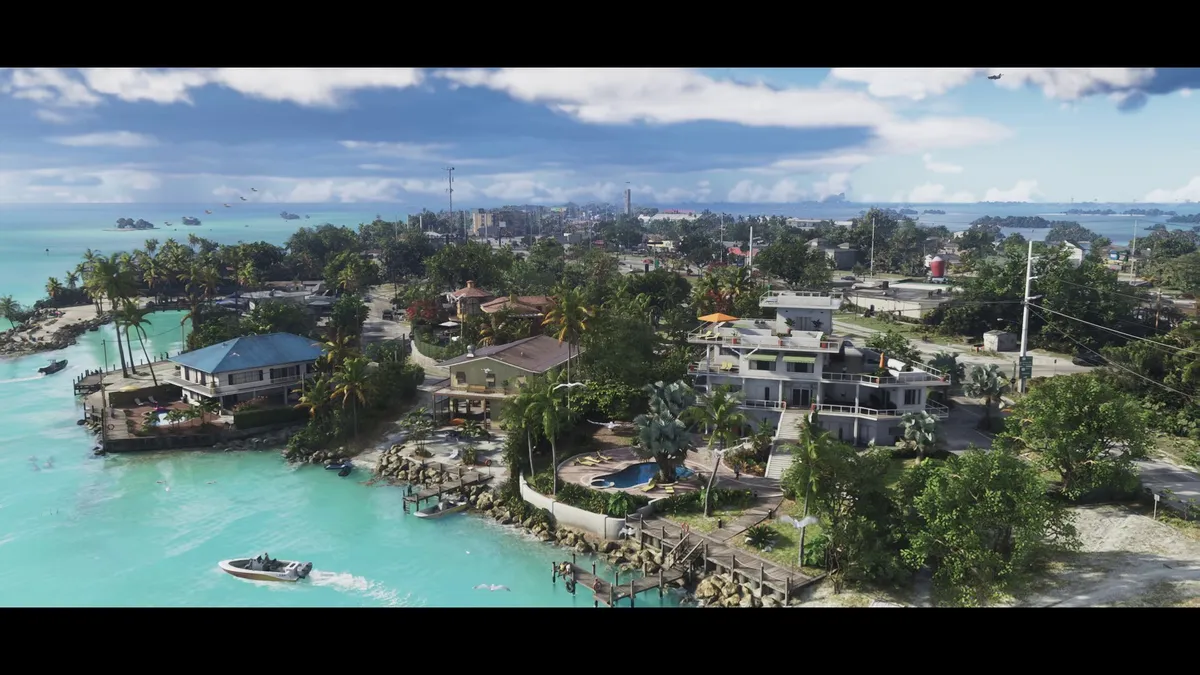
Taken individually, each of these signals could read as anecdote. Together, they form a coherent pattern: Rockstar is building Leonida as a space where layers of reality stack on top of each other, from physical infrastructure (streetlights, roads, buildings) to digital habits (phones, apps, the fictional social media feeds already visible in the December 2023 first trailer).
The challenge for the development team is not only to create these elements, but to make them consistent with one another. A Shoebox fixture in a strip mall parking lot, a streaming feed watched on a phone while a character waits, radio ads for fictional brands that also appear on roadside billboards: if these systems speak to each other, Leonida will not be a backdrop. It will be an environment.
The release date is set for November 19, 2026 on PS5 and Xbox Series X|S. The trailers make Rockstar’s ambition clear enough. The open question is how far that coherence holds once players start pushing the walls.