
GTA 6 and the RAGE Engine: PS5 Loading Times Estimated From Leaked Gameplay

Leaked Footage: The Technical Detail Worth Examining
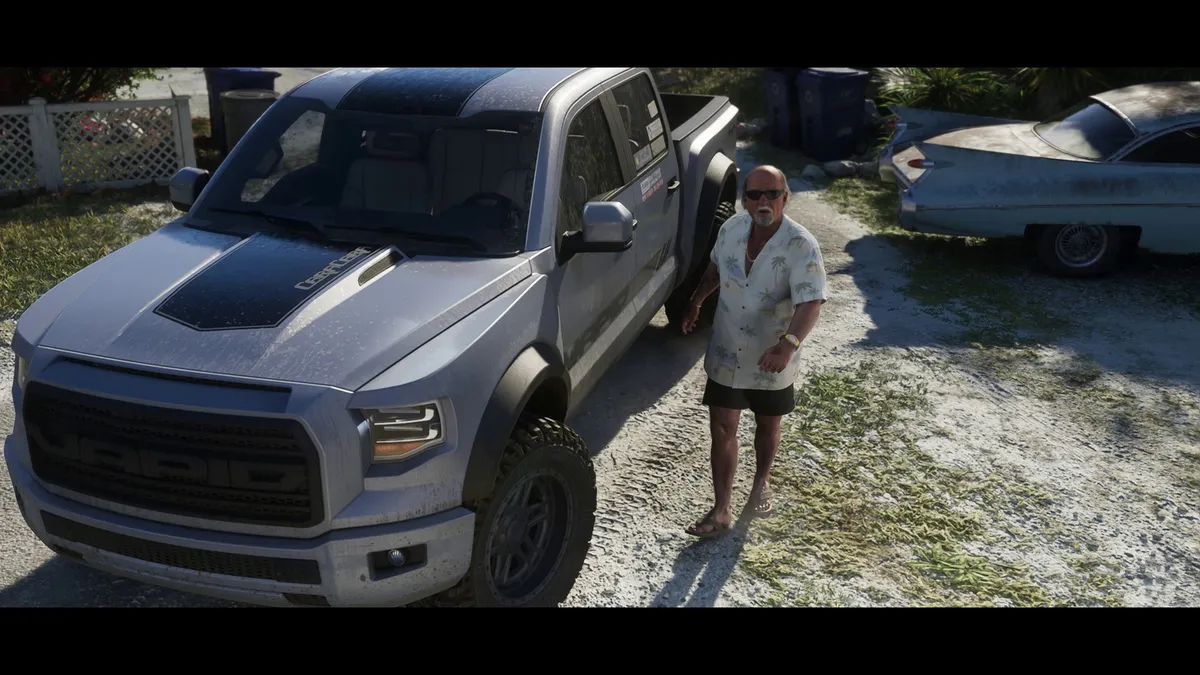
Unofficial GTA 6 gameplay that has been circulating in recent months contains a technical detail that often gets overlooked: transitions between loaded areas happen with no visible loading screen, including when entering buildings or moving between significantly different environments. This is not a marketing promise. It’s observable, frame by frame, in footage that appears to have been captured on PS5 development hardware.
For context: in GTA V on PS4, loading screen times at startup could exceed 8 minutes under certain network conditions, a documented issue that even resulted in legal consequences (Rockstar paid compensation to players in 2021 after a modder identified an O(n²) algorithm responsible for the slowdown). The PS5 version of GTA V, released in March 2022, had reduced that delay to under 30 seconds thanks to the native SSD. GTA 6 appears to push that further still.
How the RAGE Engine Handles Streaming Differently
The RAGE engine (Rockstar Advanced Game Engine) has been Rockstar’s in-house tool since GTA IV in 2008. Each major iteration has brought deep modifications, but the version developed for GTA 6 integrates two technical evolutions that directly explain what’s visible in the leaks.
First: continuous asset streaming, driven by the PS5’s SSD with a raw throughput of 5.5 GB/s (compared to roughly 50-100 MB/s for a standard PS4 hard drive). In previous versions, RAGE managed streaming predictively but sequentially, preloading probable zones based on player trajectory. On PS5, the available bandwidth allows geometry and texture blocks to be loaded on the fly, without the CPU having to stall game execution while waiting for data.
Second: the PS5’s unified memory architecture (16 GB of GDDR6 shared between CPU and GPU) reduces data copies between separate memory pools, a historically significant source of latency in open-world engines. In RDR2, transitions between biomes (grasslands, dense forests, urban areas) were occasionally accompanied by subtle stuttering, precisely because the PS4 Pro’s memory bus hit its limits during streaming spikes. This bottleneck disappears structurally on current hardware.
A Comparison With Rockstar’s Previous Next-Gen Releases
| Criteria | GTA V PS4 (2014) | GTA V PS5 (2022) | GTA 6 PS5 (expected) |
|---|---|---|---|
| Startup loading time | 4 to 8 min (Online) | ~25 seconds | Not officially measured |
| Texture streaming | HDD 50 MB/s | SSD 5.5 GB/s | SSD 5.5 GB/s + optimized RAGE |
| Interior/exterior transitions | ~2s black screen | Near-instant | No screen visible (leaks) |
| Target resolution | 1080p/30fps | 4K/60fps (perf. mode) | 4K/30-60fps (unconfirmed) |
| Map size | ~49 km² (estimated) | 49 km² | Larger (unmeasured) |
This table highlights a consistent progression: each hardware generation has allowed Rockstar to remove one layer of technical friction. Eliminating loading screens between zones is not a feat in 2026 (Ratchet & Clank: Rift Apart demonstrated it as early as 2021 on PS5), but applying it to an open world of Leonida’s density is a challenge of an entirely different magnitude.

The Limits of This Analysis and What Remains Unknown
Several caveats need to be stated clearly.
The leaked footage is not precisely dated and comes from development builds whose optimization state is unknown. Final builds are generally more optimized than intermediate versions, but they can also introduce regressions added late in the production cycle. What’s visible in the leaks does not guarantee the behavior of the commercial release.
The term “loading times” also covers distinct realities: the initial game startup, transitions between zones in the open world, respawn after death, multiplayer session loading. The leaks give indications about open-world transitions, not necessarily the others. GTA Online historically concentrated the most punishing loading times, largely due to network synchronization between players, a problem the SSD alone does not solve.
The Xbox Series X|S version raises its own questions. That platform theoretically shares comparable SSD characteristics (2.4 GB/s raw throughput for the Series X, versus 5.5 GB/s for the PS5). The raw bandwidth gap is real, and it will be worth watching whether Rockstar homogenizes the experience or whether perceptible differences remain between the two platforms at the November 19, 2026 launch.
What the leaks confirm, with the caveat that the footage’s reliability is not absolute, is that Rockstar built GTA 6 to use the SSD as a central component of the experience, not simply as an accelerator bolted onto an architecture designed for spinning disks. That is a structural choice, not a cosmetic one.
Sources
PC Checker
Will your PC run GTA 6? Unofficial estimation tool from your GPU, CPU, RAM and OS.