Vibe coding Leonida in a few weeks: the telling failure that exposes GTA 6's real scale
An AI founder, a DIY clone, and a staggering gap
GTA 6’s second trailer, released on May 6, 2025, runs just under two minutes thirty seconds. That’s enough to pose a concrete problem for anyone hoping to approach the result with code-generation tools: every second of those 150 seconds stacks layers of simulation that current AI engines simply cannot produce on demand. That’s exactly what one AI startup founder discovered, as reported by The Shortcut and Gizmodo in recent weeks. Tired of waiting for the November 19, 2026 release date, he attempted to “vibe code” his own Grand Theft Auto clone, using AI code-generation assistants over the course of a few weeks.
The result, visible and widely discussed online, lands closer to a functional prototype than a credible simulation. That’s not a criticism of the attempt. It’s precisely what makes the case interesting.

What vibe coding measures without meaning to
“Vibe coding” refers to a recent practice: delegating most code writing to a large language model (GPT-4o, Claude, Gemini) by describing desired behavior in natural language, then iterating through corrections. The method works reasonably well for web apps, utility scripts, and interface prototypes. It hits structural limits the moment coherent open-world simulation enters the picture.
This is why the exercise of “recreating GTA 6 through vibe coding” is less anecdotal than it might seem. It inadvertently provides a layer-by-layer framework for reading the real complexity of Rockstar’s project:
| Simulation layer | Vibe-coded clone (a few weeks) | GTA 6 / RAGE Engine (estimate) |
|---|---|---|
| Navigable open map | Basic terrain, rough collisions | Leonida: estimated larger than GTA V + expansions |
| Pedestrian and vehicle AI | Simple scripted behaviors | Dynamic behavioral routines, environment-reactive responses |
| Vehicle physics | Rigid model, few variables | Per-vehicle mass/suspension simulation, procedural damage |
| Weather and day/night cycle | Static texture or basic cycle | Dynamic weather visible in trailer 2: rain, flooding, fog |
| Narrative spatial density | No scripted content layer | Missions, named secondary characters, integrated fictional economy |
| Visual rendering | Generic or royalty-free assets | PBR shaders, volumetric lighting, reduced aliasing on PS5 |
The gap between the two columns doesn’t reflect a lack of talent or ambition on the vibe coders’ part. It reflects a simple industrial reality: GTA 6 has mobilized several thousand developers for at least a decade, with a production budget estimated by multiple financial analyses to be in the region of $2 billion. An AI assistant, however capable in 2025-2026, cannot compress ten years of engine engineering into a few weeks of prompts.

What Rockstar has actually built inside RAGE
The RAGE engine (Rockstar Advanced Game Engine) is not an off-the-shelf product. It has been developed in-house since the 2000s, refined through GTA IV (2008), GTA V (2013), and Red Dead Redemption 2 (2018). Each iteration added complete systems: crowd simulation in GTA IV, procedural vegetation and dynamic weather in RDR2, whose technical screenshots circulated for years as a rendering benchmark.
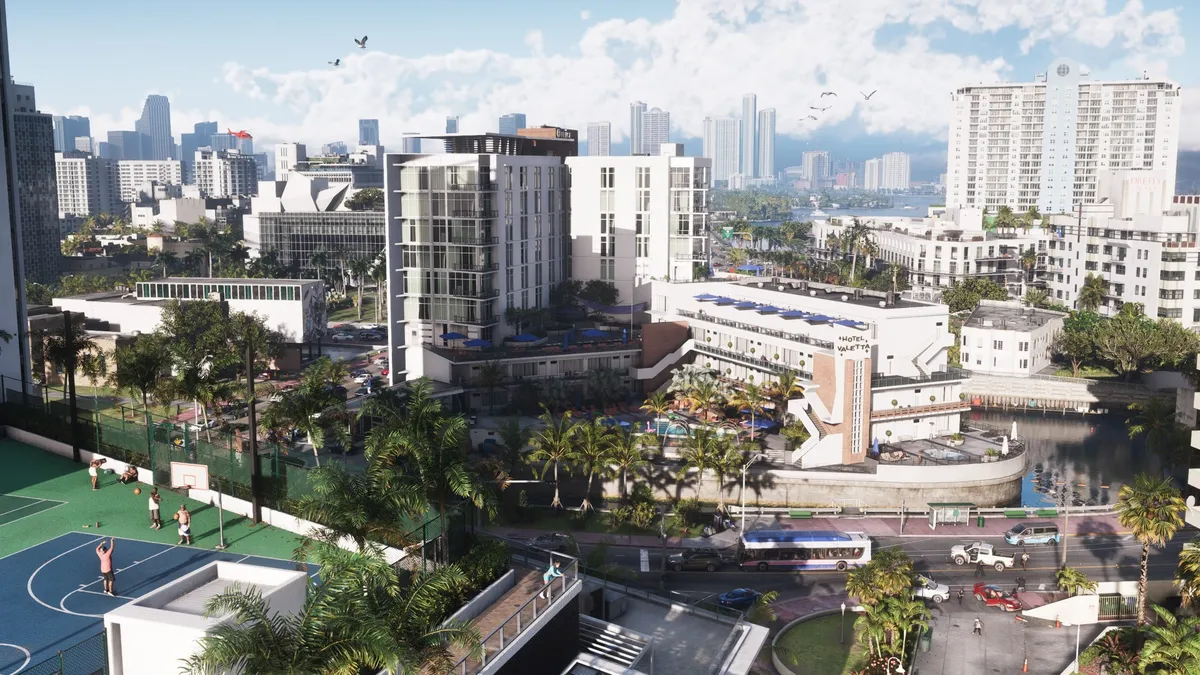
GTA 6’s second trailer shows real-time flooding that alters road accessibility, tropical vegetation reacting to wind, and a density of NPCs with distinct behavioral routines. These are not staging effects: they are simulation systems running in real time on PS5, based on what Rockstar has allowed to be perceived through official visuals. Reproducing each of those systems separately would take a specialist team months. Making them coexist without a performance collapse is an entirely different level of difficulty.
This is where the vibe coder’s experiment becomes a useful indicator: the impossibility of producing something close in a few weeks, using the best AI tools currently available, says more about GTA 6’s actual scale than any marketing communication could.
Anticipation as an involuntary benchmark
There is something symptomatic about an AI startup founder, a professional in automated content generation, choosing this route to fill the wait. The gesture itself reflects the pressure that the November 19, 2026 horizon is placing on a segment of the community: if the product isn’t here yet, try to build a substitute.
But the substitute, precisely because it exists and can be compared to the official trailers, functions as a measuring stick. It makes visible, concretely and without rhetoric, the distance between what the best current generative tools can produce quickly and what Rockstar has accumulated across a decade of development. That distance is the real measure of anticipation: not emotional, but technical.

Vibe coders will not recreate Leonida before November. Nobody will. And that, in a way, is the clearest confirmation available that what Rockstar is preparing remains out of reach of any shortcut.